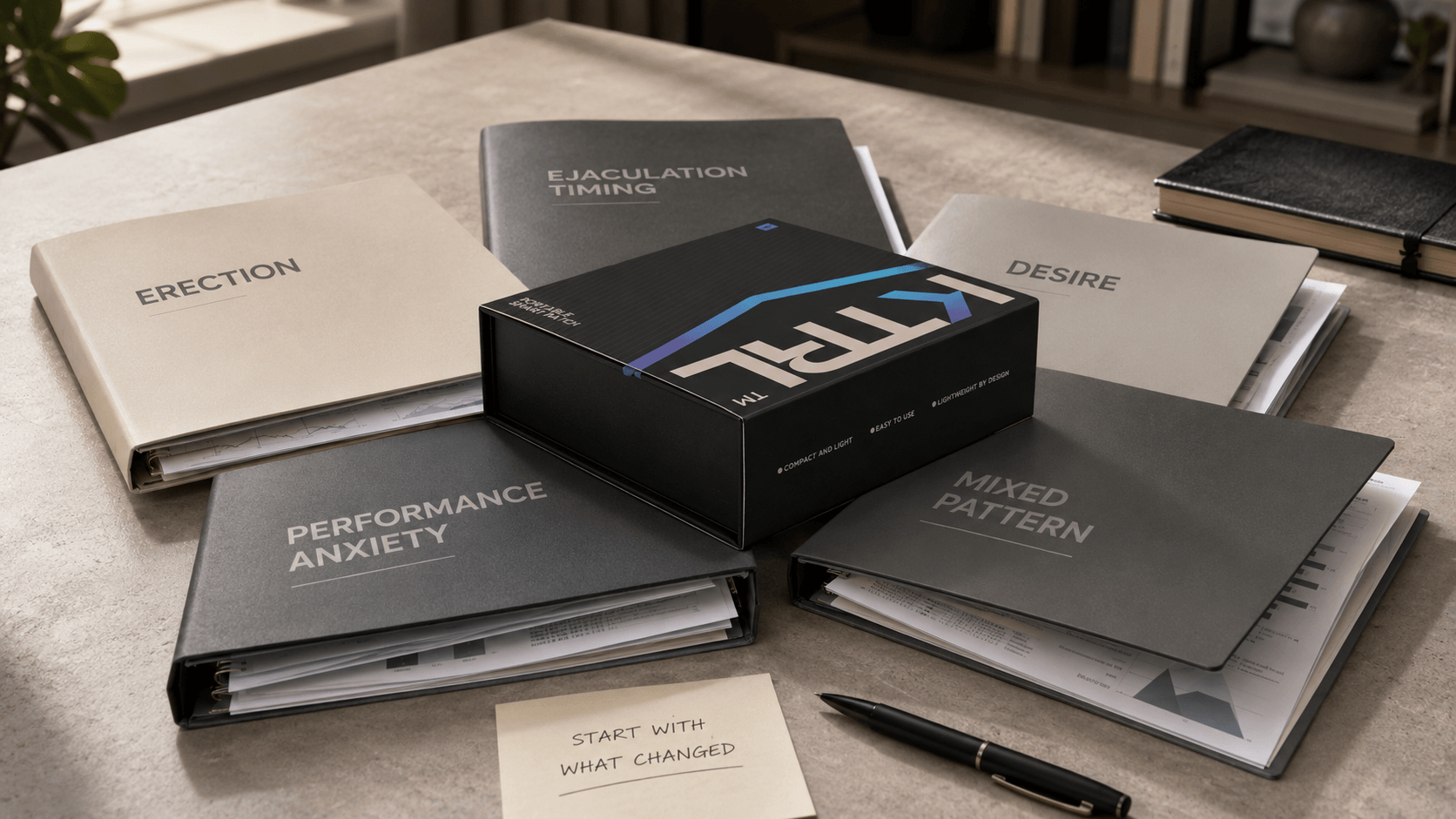
Start with the part of the experience that changed. ED mainly concerns getting or keeping an erection; premature ejaculation concerns ejaculation timing, control, and distress; low libido concerns sexual interest; performance anxiety concerns worry and self-evaluation. These patterns can overlap, so this map is a starting point—not a diagnosis.
The fastest symptom map
Your clearest question
Best starting topic
What it does not establish
“I want sex, but I cannot get or keep the erection I want.”
Erection difficulty / ED education
The cause, severity, or whether anxiety is responsible
“I ejaculate earlier than I want and feel little control or significant distress.”
Premature ejaculation education
A diagnosis from timing alone
“My interest in sexual activity has dropped or feels absent.”
Low-desire / libido education
A hormone problem from desire alone
“I am preoccupied with performing, being judged, or what will happen if my body changes.”
Sexual performance anxiety education
That the concern is purely psychological
“More than one row fits.”
Mixed-pattern review
That you must choose only one label
If no row feels exact, that is normal. People do not experience sexuality in isolated boxes. The map helps you describe the first question more precisely so that the next conversation—with a partner, clinician, or therapist—can start with better information.
Route 1: erection is the main concern
NIDDK describes ED symptoms as being able to get an erection sometimes but not every time, getting one that does not last long enough for sex, or being unable to get one (NIDDK).
This route may fit if your main sentence is:
· “I feel desire, but an erection does not start.”
· “I get hard, but I lose firmness before I want to.”
· “The response is different alone, with a partner, or in the morning.”
· “This has become a recurring change from my usual pattern.”
Questions that make this route more useful
Note whether the change is occasional or recurring, whether desire is present, whether erections occur in other contexts, whether there was a medicine or health change, and whether pain or other symptoms are present. These observations do not reveal a cause by themselves.
NIDDK notes that blood-vessel, nerve, hormonal, medication-related, emotional, and lifestyle factors may contribute to erection difficulties (NIDDK). That range is why professional evaluation uses a medical, sexual, and mental-health history rather than one online answer (NIDDK diagnosis guidance).
Continue with Why Can I Want Sex but Still Have Trouble Getting Hard? or Why Can I Get Hard but Not Stay Hard?, depending on the pattern.
Route 2: ejaculation timing is the main concern
Premature ejaculation is not simply “sex lasted fewer than a certain number of minutes.” EAU guidance evaluates timing together with perceived control, distress, and interpersonal context, and distinguishes lifelong and acquired patterns (European Association of Urology).
This route may fit if:
· ejaculation repeatedly happens earlier than you want;
· you feel little control over the timing;
· the pattern causes personal or relationship distress; or
· you begin avoiding intimacy because you expect the same outcome.
Do not confuse urgency with lack of attraction
Rushing may be connected to anxiety, habit, high arousal, or other context, but it does not automatically mean a man cares less about his partner. Likewise, a partner’s disappointment should not be dismissed. Both experiences can be acknowledged without turning timing into a verdict on either person.
If erection difficulty and early ejaculation occur together, mention both to a qualified clinician. Treating one as the only “real” issue can hide the pattern that needs assessment. Continue with the cluster’s early ejaculation education guide when it is live.
Route 3: desire or libido is the main concern
Low desire concerns reduced interest in sexual activity, sexual thoughts, or fantasies, with the person’s context and distress taken into account. It is not the same as ED. EAU guidance treats low sexual desire as its own domain and emphasizes biological, psychological, interpersonal, and cultural context (European Association of Urology).
This route may fit if your main concern is:
· “I am less interested than I used to be.”
· “I can respond physically, but I rarely want to start.”
· “I care about my partner, but sexual interest feels muted.”
· “My desire changed after stress, illness, a relationship shift, or a medicine change.”
Erection does not equal desire, and desire does not require an erection
A physical response can occur without a conscious wish to continue, and desire can be present without the erection someone expects. Consent still depends on an active choice—not on a body sign.
Do not assume a testosterone problem from low interest alone. Hormones can be relevant in some cases, but desire has multiple possible influences and deserves context. The next route is the male low-desire guide.
Route 4: pressure and self-monitoring are the main concern
Performance anxiety centers on expectation, evaluation, and perceived consequences. It may show up as worry, self-monitoring, shame, distraction, or avoidance, according to a 2025 expert position statement in Sexual Medicine Open Access (SMOA).
Questions that point toward performance pressure
This route may fit if you spend much of the experience asking:
· “Is my body responding correctly?”
· “What does my partner think?”
· “What if last time happens again?”
· “Am I taking too long or not long enough?”
Anxiety can coexist with erection or ejaculation concerns. Its presence does not prove that physical context is irrelevant. Start with What Is Sexual Performance Anxiety? and seek qualified support if worry, avoidance, or distress keeps affecting intimacy or daily life.
Route 5: more than one pattern fits
Examples of overlapping patterns
Mixed patterns are not unusual in clinical assessment. For example:
· desire is present, an erection starts, then self-monitoring increases and firmness changes;
· early ejaculation creates worry before the next encounter;
· low desire leads to less frequent intimacy, which makes each encounter feel higher-stakes;
· erection difficulty creates avoidance, and a partner interprets distance as rejection;
· stress affects desire, attention, sleep, and relationship communication at the same time.
The EAU recommends a comprehensive medical and sexual history that includes desire, arousal, ejaculation, orgasm, erection rigidity and duration, and stimulated and morning erections (EAU ED management). You do not need to force a mixed experience into one label before asking for help.
A five-minute pattern note for yourself or a clinician
Write short, factual answers—no score and no blame.
1. Domain: Was the main change desire, erection, ejaculation timing, orgasm, comfort, or anxiety?
2. Frequency: One event, occasional, frequent, or nearly every attempt?
3. Context: Alone, with a partner, in the morning, under time pressure, after alcohol, or across situations?
4. Timeline: Always present, gradually changing, or suddenly different?
5. Impact: Mild curiosity, personal distress, avoidance, or relationship conflict?
6. Changes: New medicine, illness, pain, injury, sleep disruption, or major stress?
This note cannot diagnose you. It can reduce the pressure to remember everything during an appointment and help a partner understand that the problem is not automatically rejection.
When relationship strain enters the picture
A sexual concern may remain private for one person but become relational through silence. One partner may withdraw to avoid embarrassment; the other may experience the withdrawal as lack of attraction. Repeated guessing can produce arguments about the relationship when the original issue was a body response, anxiety, desire change, or a mixture.
A neutral opening can help:
“I do not yet know which label fits. I know I care about you, and I do not want us to treat this pattern as proof that either of us is the problem. I am going to track what changed and get appropriate help if it continues.”
The goal is clarity, not a promise that every intimate experience will follow a particular script.
When to seek professional support
Arrange qualified care when a change is persistent, recurring, distressing, or affecting your relationship or wellbeing. Seek care sooner for pain, injury, new urinary or neurological symptoms, a sudden major change, or symptoms that began after a medicine change. Do not stop a prescribed medicine on your own.
A primary-care clinician or urologist can assess health and medication context. A licensed therapist or qualified sexual-health professional may help with anxiety, shame, communication, and avoidance. The appropriate route can include more than one professional.
Where an adult wellness product belongs in this map
An optional adult wellness product belongs in a routine-choice lane, not in a diagnosis lane. If your question is “What is causing a recurring erection, ejaculation, or desire problem?” assessment comes first. If your goal is “How do I create a discreet, deliberate sensory routine without treating my body like a test?” you can evaluate a product on intended experience, instructions, privacy, cost, and fit.
Use the discreet male wellness routine guide for that separate decision. Join the KTRL email list if you prefer more education before considering a purchase.
Product disclaimer: KTRL Portable Smart Patch is a consumer electronic product intended for adult external skin-surface contact use only. It is not a medical device and is not intended to diagnose, treat, cure, or prevent any disease or medical condition. Individual experience may vary. Always read and follow the printed product instructions. Stop use immediately if discomfort occurs, and seek qualified professional advice for persistent or distressing sexual health concerns.
Frequently asked questions
Can I have normal desire and still have ED symptoms?
Yes. Desire and erection are different parts of sexual experience. Wanting intimacy does not by itself determine whether an erection starts or lasts. Recurring or distressing erection difficulty deserves appropriate evaluation.
Can anxiety and a physical contributor exist together?
Yes. Health, medicine, emotional, cognitive, and relationship factors can overlap. Noticing anxiety should not end the assessment of other relevant context.
Is this symptom map a diagnostic test?
No. It is a vocabulary and routing tool. Diagnosis requires an appropriate history, examination, and selective testing when indicated.